Copy Trading Is a Total Scam

I just got out of the shower, opened X, and saw yet another wave of people promoting Polymarket copy-trading tools.
I couldn’t take it anymore.
So today, I’m going to tell you why copy trading is a total scam.
First, let me ask you one question.
Who do you know who has actually become rich through copy trading?
And pay attention: I didn’t ask who has made some money. I said rich.
Not ten dollars. Not a hundred dollars. I’m talking about one million dollars. Life-changing money, made by copying other people’s trades.
Name one person.
Can you?
Now look closely at the people telling you how great copy trading is. Every road eventually leads to the same place: their copy-trading tool.
They charge a subscription. They take a cut of the fees. They collect referral commissions from your trading volume.
They are not getting rich from copy trading. They are getting rich by selling copy trading to you.
That is the most disgusting part.
You need your trades to be profitable before you make money. They only need you to subscribe, deposit, and keep trading.
They need you to keep playing. They do not need you to win.
Now let me tell you why you will not make money from copy trading.
Reason Number One: You Copy the Trade. They Make Money From the Timing.
And you are always one step behind.
Imagine a bot trading five-minute Bitcoin markets with an incredible-looking win rate.
Would you copy it?
A lot of these bots are not making money because they are better at predicting what will happen. They are making money because of timing.
They buy while an outcome is still cheap. Then, when the price moves in their favor, they sell quickly and lock in the profit.
Copy trading sounds beautifully simple:
They buy, I buy. They make money, I make money.
But there is a fatal mismatch hidden inside that idea.
Between their trade and your copied trade, there is a chain of delays that you can never completely remove.
Their strategy sends an order.
Their order gets filled.
Your monitoring system detects that fill through an API or on-chain data.
The signal reaches your program.
Your program creates another order.
That order travels back to the market.
And finally, your order gets filled.
Every single step eats into the edge.
On-chain data has confirmation delays. Monitors have polling intervals. APIs have rate limits. Networks have latency. Orders have slippage.
Even under optimistic conditions, you may still be several seconds—or even tens of seconds—behind.
And in a five-minute market, a few seconds can be the difference between heaven and hell.
What makes this even worse is that the delay does not hurt you randomly.
It hurts you systematically.
When the market suddenly shoots higher, they are already in at the lower price.
By the time their trade reaches your system, the price has already moved.
You are the one buying high.
When the market reverses, they get out first.
Your exit signal is still travelling through the system.
By the time you sell, most of the profit may already be gone—or the loss may already be much worse.
You enter winning trades late. You exit losing trades late.
Do that long enough, and you are structurally designed to underperform the person you are copying.
So let’s return to the original question.
Are there profitable bots trading five-minute Bitcoin markets?
Absolutely.
Can you simply copy them?
No.
Their edge is being ahead of you.
The moment you copy them, you are already behind.
If you do not have your own strategy, that timing gap is something you can never truly close.
Reason Number Two: You Cannot Tell a Skilled Trader From a Lucky Survivor
What do I mean by that?
Let me explain it with a classic example from Fooled by Randomness: survivorship bias.
Imagine ten thousand people standing in a room. Every person has a coin, and they all flip at the same time.
Heads stays. Tails goes home.
Five thousand survive the first round. Twenty-five hundred survive the second. Then twelve hundred and fifty. The process continues.
After ten rounds, a handful of people will still be standing.
They have just flipped heads ten times in a row.
Now put those people on a stage.
The crowd starts screaming: “Ten heads in a row! These people are coin-flipping gods! Follow them!”
But you and I both know the truth.
They have no special ability. They are simply the luckiest random outcomes from a group of ten thousand people.
On the next flip, their odds are still fifty-fifty—exactly the same as everyone else’s.
That is survivorship bias.
The key question is not whether the people on stage look like geniuses. The key is that you only see the winners on the stage.
You never see the other nine thousand nine hundred people who used the same method and were eliminated along the way.
The “gurus” shouting “copy me and earn passive income,” and the beautiful profit curves you discover on-chain, may simply be the survivors who are still standing after a giant coin-flipping contest.
Now let’s be generous. Suppose you genuinely believe that one wallet might have some skill.
My next question is simple:
How much data did you study before deciding that this was a “smart-money wallet”?
Why does a casino make money?
It does not win every hand. It makes millions of bets and allows a tiny statistical advantage to compound over time.
The casino operates across millions of trials.
You are looking at one wallet across a short window.
Over a short enough period, someone trading randomly, taking reckless risks, or simply getting lucky can produce a spectacular profit curve.
Does that make them skilled?
Did you observe that account for long enough to know?
Countless wallets make money for one month and blow up the next.
I found one wallet:
0x3657862e57070b82a289b5887ec943a7c2166b14
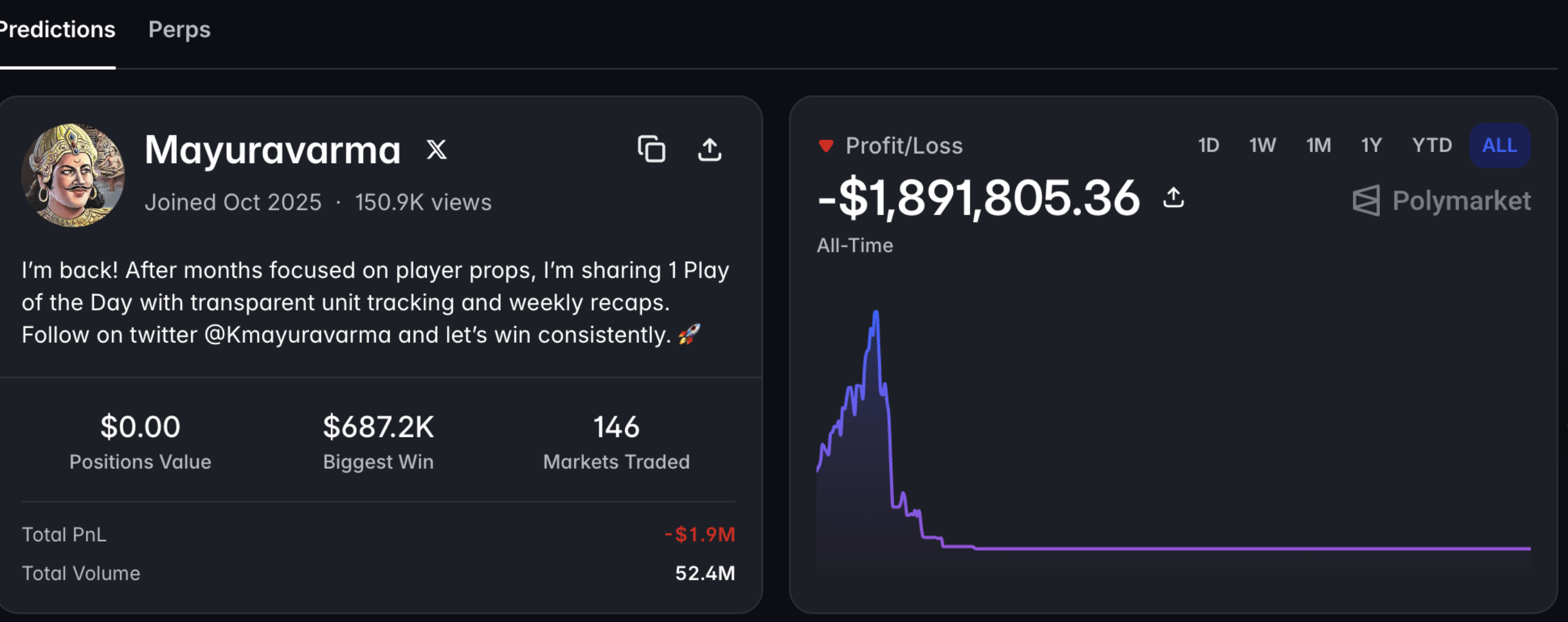
It entered the market in October 2025.
Within roughly one month, by the middle of November, its reported profit had climbed to almost four million dollars.
Four million dollars. In one month.
If you had discovered that wallet at the time, you would have thought: this person is a god. I have to copy them.
Then what happened?
From that peak of nearly four million dollars, the curve went straight down.
Loss after loss after loss.
The entire four-million-dollar profit disappeared. Then the wallet fell to nearly two million dollars in the red.
The X account disappeared, and the Polymarket account went silent.
From positive four million to negative two million: a drawdown of nearly six million dollars.
One month to become a god. Two months to blow up.
And the people who started copying at the top?
They followed that wallet all the way down the six-million-dollar cliff.
Reason Number Three: You See the Trade. You Do Not See the Strategy Behind It.
Copy trading replaces one bet with another.
You stop betting on your own judgment and start betting that a stranger will keep winning.
The target changes. The gamble does not.
And here is the most ridiculous part: you understand and control that anonymous address even less than you understand and control yourself.
You can see the trade.
You cannot see the full position, the risk management, the exit plan, the hedges, or the off-platform assets behind it.
Maybe the wallet bought one million dollars of Yes.
You do not know whether the same person holds three million dollars of No in another wallet.
You do not know whether they have related positions on another platform.
You do not know whether this trade represents two percent of their net worth while your copied position represents your entire life savings.
You cannot see their risk management.
You do not know how much they are prepared to lose. You do not know when they plan to take profit. You do not know whether the trade you copied is the bet, the hedge, or the bait.
Copy trading can be even more dangerous than openly gambling because it dresses the gamble in a respectable costume.
“I’m following smart money.”
“I’m being rational.”
“I’m using data.”
That story makes you feel safe. And because you feel safe, you bet more.
That false sense of security is the real poison.
Why do people want to copy trade in the first place?
Because they want a shortcut.
They do not want to do the work of understanding the market. They want to find a god and outsource their brain to him.
But every brain you outsource eventually comes back as money missing from your account.
Reason Number Four: The Only Thing Worth Copying Is the Thinking
Why are we so desperate to copy someone else?
Because we want to believe that somewhere out there, there is an answer, an expert, a wallet, or a method that never loses.
Then we never have to think for ourselves.
But markets do not work that way.
Markets change every day. A strategy that works today may be dead six months from now.
A wallet cannot stay with you for the rest of your life.
Judgment can.
I am completely fine with using wallets as signals.
Watch what they buy. Study their timing. Analyze their behavior. Let that information challenge your own view.
But the final decision to place the trade has to be yours.
The moment you blindly copy an address, you hand your judgment—and your money—to an anonymous wallet.
The thing worth automating is not the copying of somebody else’s trades.
Automate your research. Automate your monitoring. Automate your alerts.
Then use those tools to sharpen your own thinking.
Because this is your money.
This is your life.
Do not copy trade.
No one can think for you. No wallet can consistently earn money for you beyond the limits of your own understanding.
You can copy a lucky streak.
You cannot copy judgment.
And when the market turns violent, judgment is the only thing that will keep you alive.