This is a textbook ternary-search problem: find an extremum over an interval.
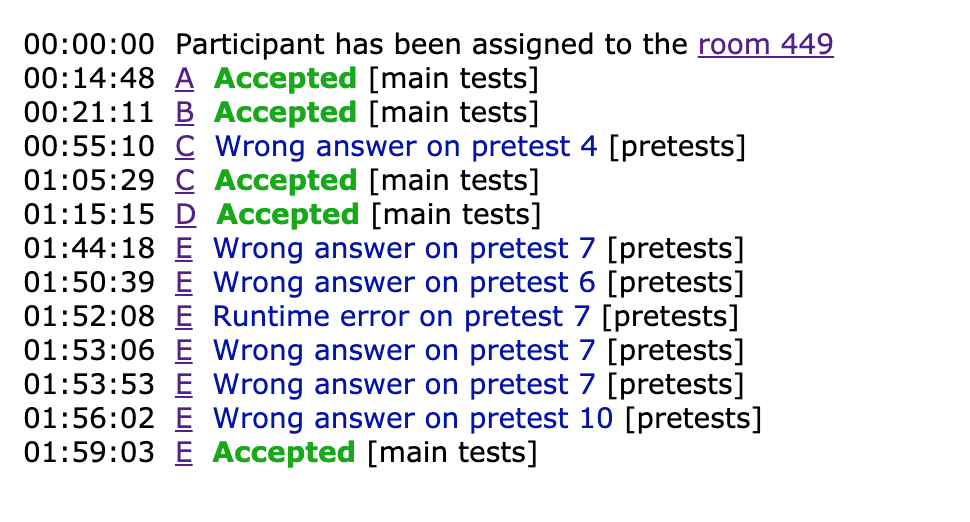
What on earth was I doing, though? I finally got it accepted in the last minute. I am back to the purple rating again. I want to reach 2100 this year; if I can become consistent, it is not impossible.
Codeforces really rewards boldness: dare to think, do, and try. For Problem D, I submitted an approach I barely understood and it passed. I expected to finish with two problems at my level, but I solved three in the final hour.
I also wrote a pseudo-algorithm version and it passed. Analyse the possible exchanges: only three target values need consideration—sum / n, and, when the remainder is non-zero, two neighbouring values.
1
2
3
4
5
6
7
8
9
10
11
12
13
14
15
16
17
18
19
20
21
22
23
24
25
26
27
28
29
30
31
32
33
34
35
36
37
38
39
40
41
42
43
44
45
46
47
48
49
50
51
52
53
54
55
56
57
58
59
60
61
62
63
64
65
66
67
68
69
70
71
72
73
74
75
76
77
78
79
80
81
82
83
84
85
86
87
88
89
90
ll n,a,r,m; ll val[maxn]; ll pre[maxn], t1[maxn],t2[maxn]; void solve () SLLA (n); SLLA (a); SLLA (r); SLLA (m); REPP (i,1 ,n) { SLLA (val[i]); t1[i] = val[i]; t2[i] = val[i]; } sort (val+1 ,val+1 +n); sort (t1+1 ,t1+1 +n); sort (t2+1 ,t2+1 +n); REPP (i,1 ,n) { pre[i] = pre[i-1 ] + val[i]; } ll A = a; ll R = r; ll ans = LL_INF; REPP (i,1 ,n) { ll fix = val[i]; ll p = pre[i-1 ]; ll need = (i-1 )*fix - p; ll suf = pre[n] - pre[i]; ll nedre = suf - (n-i) * fix; ll tmp = need*A + nedre*R; ans = min (ans, tmp); ll cnt = min (need, nedre); need -= cnt; nedre -= cnt; tmp = cnt*m + need*A + nedre*R; ans = min (ans, tmp); } if (pre[n] % n == 0 ) { ll s = 0 ; REPP (i,1 ,n) { s += abs (pre[n]/n - val[i]); } ans = min (ans, s/2 *m); } else { ll sur = pre[n]%n; ll anst1 = sur*R; ll cn = sur; ll ind = n; ll sum = pre[n]; sum -= sur; while (cn>=1 ) { while (cn>=1 && t1[ind] > sum/n) { t1[ind]--; cn--; } ind--; } ll tmp = 0 ; REPP (i,1 ,n) { tmp += abs (sum/n - t1[i]); } ans = min (ans, tmp/2 *m+anst1); ll sur_sum = n - pre[n]%n; sum = pre[n] + sur_sum; int cntt = 0 ; int i = 1 ; while (cntt < sur_sum) { while (t2[i] < sum/n && cntt < sur_sum) { cntt++; t2[i]++; } i++; } ll anst2 = sur_sum*A; tmp = 0 ; REPP (i,1 ,n) { tmp += abs (sum/n - t2[i]); } ans = min (ans, tmp/2 *m + anst2); } printf ("%lld\n" , ans); }
The ternary-search solution below is adapted from quality:
1 2 3 4 5 6 7 8 9 10 11 12 13 14 15 16 17 18 19 20 21 22 23 24 25 26 27 28 29 30 31 32 33 34 #include <bits/stdc++.h> using namespace std;typedef long long ll;const int MAXN=100005 ;int h[MAXN];int main () int n,A,R,M; scanf ("%d%d%d%d" ,&n,&A,&R,&M); M=min (M,A+R); for (int i=1 ;i<=n;i++) scanf ("%d" ,&h[i]); auto f=[&](int t)->ll { ll cnt_a=0 ,cnt_r=0 ; for (int i=1 ;i<=n;i++) { if (h[i]<t)cnt_a+=t-h[i]; else cnt_r+=h[i]-t; } ll cnt_m=min (cnt_a,cnt_r); cnt_a-=cnt_m,cnt_r-=cnt_m; return A*cnt_a+R*cnt_r+M*cnt_m; }; int tl=0 ,tr=1000000000 ; while (tl<tr) { int tm1=tl+(tr-tl)/3 ; int tm2=tl+(2 *tr-2 *tl+2 )/3 ; if (f (tm1)>f (tm2))tl=tm1+1 ; else tr=tm2-1 ; } return 0 *printf ("%lld\n" ,f (tl)); }